Well,
if
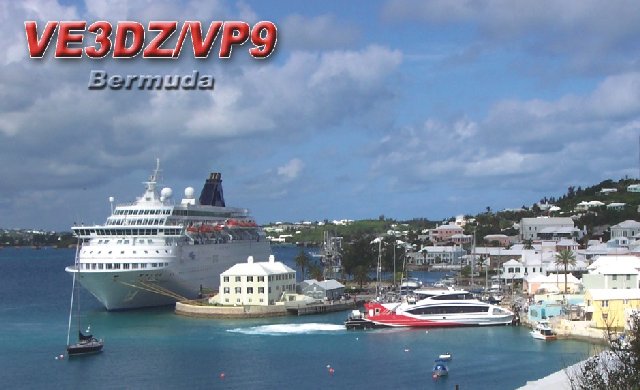
there are some places on the Earth which may be called Paradise, then
Bermuda
is definitely one of them. The streets are super clean and beaches are
the best
I've seen in my life. Looks like for the WPX CW it was the right
place,
where I appeared to show at the right time (considering band
conditions)!
I have never been to VP9 before and I was very happy to have
an opportunity to combine business trip and pleasure, being able to
operate yet
another Contest from a DX Location.
Mr. Ed Kelly, VP9GE offers nice apartments and station for
rent, details may be found on
www.vp9ge.com
.The station and antennas look quite modest at first sight, but boy -
was I
mistaken about it! When I first started operating on Thursday night
before the
Contest using just bare radio and A4S tribander I was amazed by signal
reports
from the EU and Eastern U.S. - mostly “59” or
“59 Plus”. All antennas
are quite low above “ground” level, but probably
the most important thing is that
ground is very poor on Bermuda (mostly rock) and Ed lives on a top of
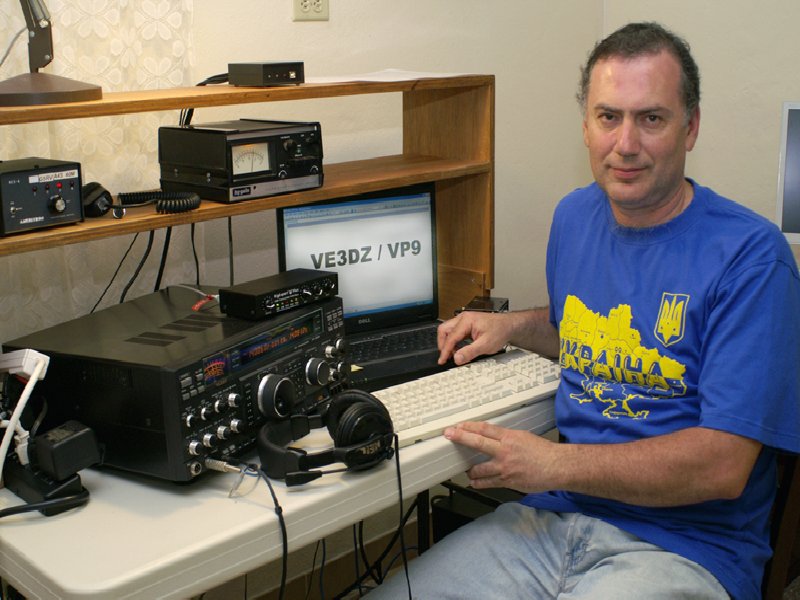
the hill. Ed provided two radios - FT1000 and FT920, I just had to
bring my RigExpert USB interface for CAT, PTT and CW keying and my Dell
laptop.
I intended to use my SO2R box, but unfortunately at that moment the
R6000
vertical was not available (broken) which made SO2R operation
impossible.
I was quite busy on Thursday and most of the day on Friday
so didn't have a chance to play much on the bands before the Contest.
However, when I started on 20, the pile-up was really good and I ended
up
with 146
Q's in the first hour - my best hour in this contest. Most of my
contact were U.S. East Coast though. 40 and 20 were open all night, and
I made a few 80 m
Q's (even into EU!) with 1 contact on 160 (I guess Brian VE3MGY
appreciated the
rare VP9 mulitplier that called him on top band!). 40 metres was
amazing! I
had a feeling that I was really LOUD at times. But honestly, I always
had
to pick my
run frequencies higher up the band to avoid QRM from big guns fighting
for
the band edge. I worked my last EU on 40m around 06:30 UTC before
making
my first break for a short nap.
One little secret, which is not so secret for those who live
in North America outside U.S., is to work a lot of 80 and especially
40m Q's
for double points. You get double points for each European on low
bands, but in
addition to that you get 4 points for each U.S.
station worked, which makes it more than if you would work EU on high
bands!
For years, while operating LP from home, my strategy was to work as
many U.S.
stations on 40 m in the morning as possible, which sometimes brings you
not
only double points, but also rare U.S.
prefixes (multipliers). The big guns are fighting on 20 for the good
run
frequency in order to work EU and you just keep collecting your double
points. Anyway, sooner or later you still have to go back to 20 metres
and
that's where
problems begin. I could not establish run frequency up until
probably
1600 UTC,
unless I pointed my beam to the U.S.
which immediately resulted in the pile-up from East Coast. I believe
VP9 is
ideal QTH for the ARRL - I was able to work U.S.
with no problems on all 6 bands Anyway, my rate sucked
quite a bit in
the
morning hours varying from 92/hr (best) to 36/hr (worst). I believe
in the
desire of getting double points on 40 I missed a 20 m opening
to JA, but the good news was that 15
suddenly opened to EU. I was making some EU contacts on 15 when Mr.
Murphy
decided that everything was probably going to well for me and sent a
local guy
in the truck down the street to hit the pole and the power disappeared
right
when I was trying to copy an exchange (sorry, OE5CWL!). That was my 2nd
(not planned) break. Fortunately, Ed was able to run emergency
generator
and
after an hour and a half I was back in business and even managed to
catch the
remains of sporadic opening to EU on 10 metres. Then again, 20 metres
in the
late afternoon and later in the evening 40 metres were great with
reasonably
good rates of 100+/hr. I started to feel that I'm falling
asleep at the
keyboard and took my last 6 hour break around 0500 UTC.
Sunday was pretty much the same - trying to stay
on 40 for
as long as possible to work 4-pointers, then struggling on 20 and 15,
except
this time 15 metres produced almost no Europe. 10 was reasonably good,
but
again - to Stateside only. Again I was surprised how sharp
the A4S was on
10 metres. I decided to call CQ for a couple of minutes towards EU and
turned
antenna to NE. After few CQs I decided to point back to the U.S.
and when I turned my beam back to my
surprise there was a K8 calling CQ TEST on my frequency. Needless to
say that
we absolutely did not hear each other. I stayed on each band for about
15-20 minutes in
order to
maintain some rate until late afternoon when 20 started booming again
into Europe.
Many times when I was trying to copy serial number from a weak
European, some
big gun would suddenly appear on my frequency and start calling CQ TEST
without
any warning!
Last couple of hours were really good on 20 and 40
with both
EU and NA in the log. I finished with a bit less than 2600 QSO, which
was an
unexpected surprise for me. Thanks again to Ed, VP9GE, for providing a
station
for this operation and to everybody who called for all the contacts.
Looking
forward to work you all again. Special thanks to Paul, VE3TA for his
help and
support.
73 Yuri VE3DZ / VP9
Anyway, just to clarify on this subject (see
information
above) - the power limit in VP9 is 150 watts and amplifiers
are not
permitted
on the island.
[small
portions of this text were edited to remove extraneous HTML content -
Ed]